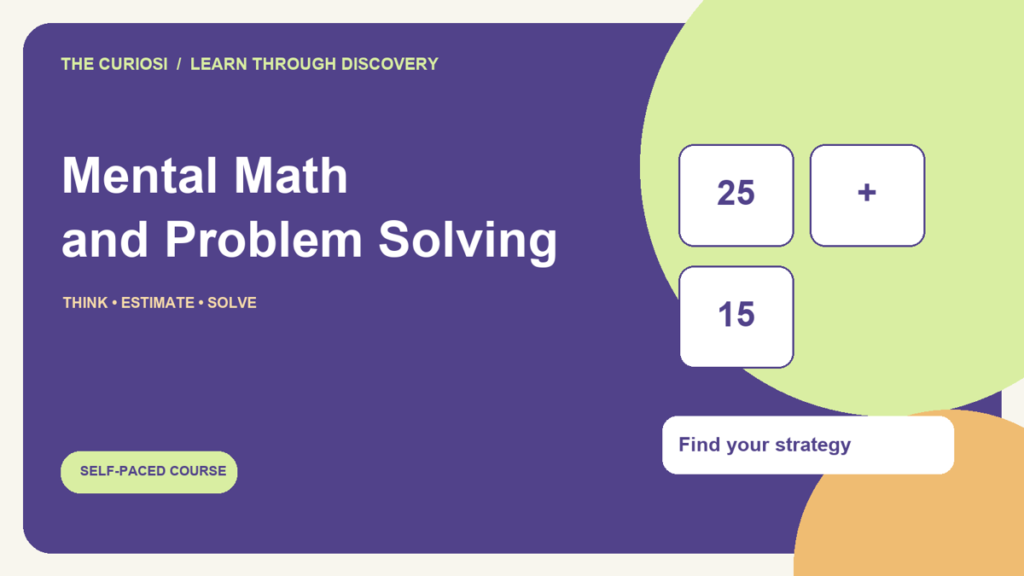
Mental math tricks for kids work best when they are flexible strategies learners understand and can explain. This intermediate course is for students in Grades 3–5, about ages 8–11, who are ready to build on basic addition and subtraction. Parents and teachers can support learners by asking them to describe their thinking, draw a quick model, or check whether an answer makes sense.
The course begins with number bonds and place-value ideas, then explores mental addition, subtraction, doubling, halving, rounding, and estimation. Learners use bar models and number lines to understand word problems before solving multi-step situations. Each lesson introduces practical examples and a short activity with an answer so learners can check their reasoning. The final project brings the strategies together in a planning challenge.
What you will learn
- Break numbers apart and recombine them using number bonds and friendly numbers.
- Add and subtract mentally with place value, compensation, and counting strategies.
- Use doubles, near doubles, and halving to connect number facts.
- Round and estimate to check whether an exact answer is reasonable.
- Draw bar models or number lines to organize word problems.
- Plan, solve, label, and check multi-step problems.
Prerequisites
Learners should be comfortable with basic whole-number addition and subtraction and have some familiarity with place value. Multiplication facts can be helpful but are not required for most lessons. Paper and pencil are optional; quick sketches can support thinking without replacing mental strategies. If a learner finds a step difficult, use counters, a number line, or an adult’s worked example before returning to mental practice.
For parents and teachers
Accept different correct strategies when learners can explain them. Ask what each number represents, whether the units match, and how the answer can be checked. Encourage understanding and accuracy before speed.