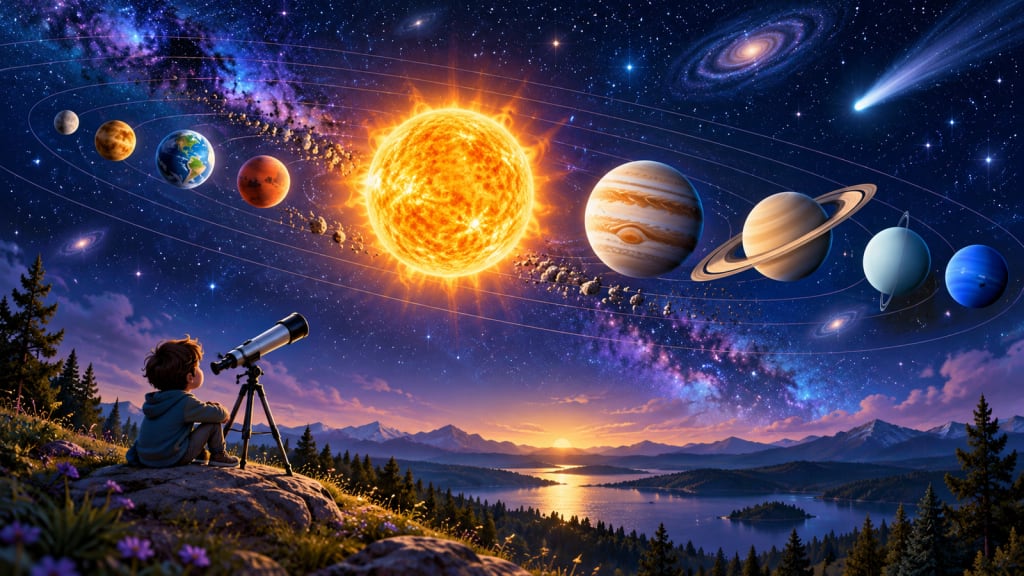
Blast off with The Solar System and Space, a free science course that brings the solar system for kids to life. In eight lessons, young astronomers travel from the blazing Sun to icy Neptune, discover why the Moon changes shape, find out what causes day, night and the seasons, and learn how humans explore space.
Space is full of big questions. Why is Mars red? Why does Saturn have rings? Why is it hot in summer? This course answers these questions with clear explanations, simple models you can make at home and fascinating facts. Every lesson ends with a short quiz and answers so learners can check what they have learned.
What you will learn
- Describe the Sun and explain why it is so important for life on Earth
- Name the eight planets in order and describe each one
- Explain the phases of the Moon
- Explain how Earth’s spin causes day and night, and its tilt causes the seasons
- Describe stars, constellations, dwarf planets, asteroids and comets
- Describe key moments in space exploration
Who this course is for
This course is for students in Grades 3 to 5 (about ages 8 to 11) and anyone curious about space. No science background is needed.
A note for parents and teachers
Several lessons include simple hands-on models using a torch, a ball and a few household items. These models make tricky ideas, like moon phases and seasons, much easier to understand. One important safety rule appears in this course: never look directly at the Sun, even through sunglasses, binoculars or a telescope. Space science keeps changing as scientists discover new things, so some numbers, such as how many moons a planet has, may change over time. Encourage learners to see that as part of the excitement of science.
How the course works
There are eight lessons of about ten to fifteen minutes each. The final lesson includes a project: making a scale model of the solar system.