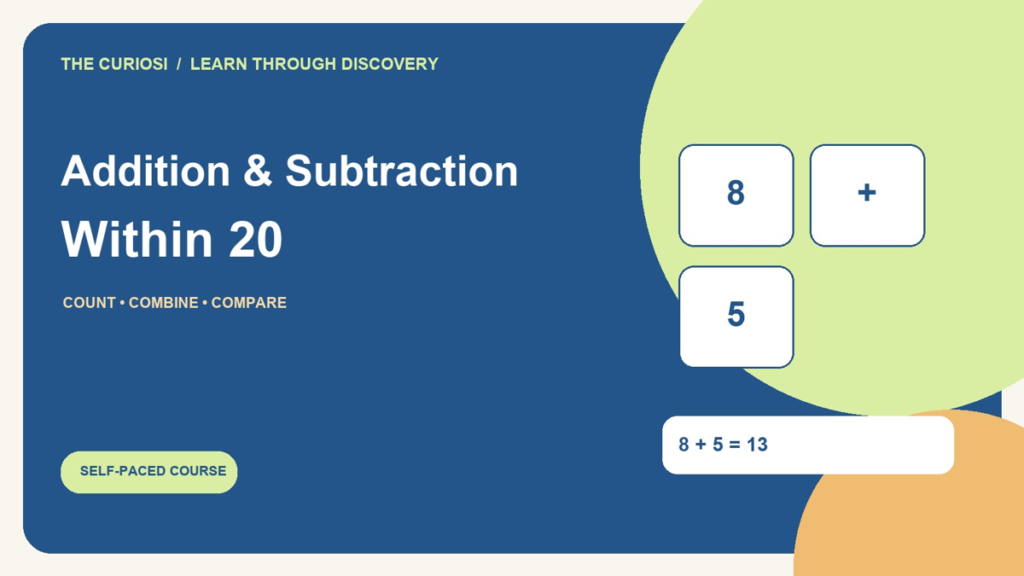
Addition and subtraction for kids begin with clear, useful ideas: joining groups, taking some away, and finding how many remain. In this beginner course, children use small objects, number lines, drawings, and familiar stories to understand sums within 20. The goal is to make sense of each problem and choose a strategy that feels helpful.
The eight lessons move from hands-on counting to flexible thinking. Learners first join and separate groups, then use number lines to count forward and backward. They practise doubles, use pairs that make ten, and see how addition and subtraction facts belong together. In the final lessons, they solve everyday word problems and create a small math story of their own.
What you will learn
- Show addition as joining groups and subtraction as taking away
- Use objects, drawings, and a number line to solve problems within 20
- Use doubles and near doubles to find sums
- Break numbers apart to make ten and solve related facts
- Choose an operation in a simple word problem and explain the answer
Who this course is for
This course is for children around ages 6 to 8 in Grades 1 and 2, and for other early learners who want more practice. Parents, teachers, and caregivers can read the examples aloud and help learners use everyday objects as counters.
Prerequisites
Learners should be comfortable counting small groups and recognising some numbers up to 20. They do not need to memorise every addition or subtraction fact before beginning. Paper, a pencil, and up to 20 small safe counters—such as blocks, buttons, or paper squares—are useful but optional.
A note for parents and teachers
Children may use different strategies and still reach the same correct answer. Encourage them to show how they thought, then compare another method. Use counters that are too large to swallow and supervise young children. If a learner is unsure, return to a smaller number and build up slowly. Keep practice calm and celebrate careful thinking.