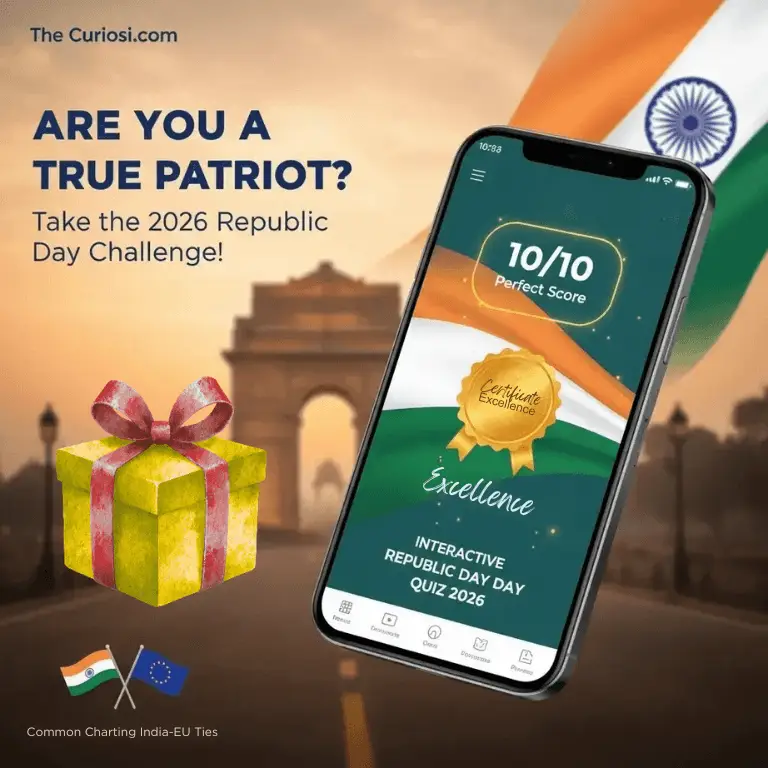
Are you ready to test your knowledge and celebrate Republic Day like never before? We invite you to participate in our exciting Republic Day Quiz! This is not just any quiz—it’s your chance to showcase your skills and potentially win an amazing free gift!
How It Works
Participating in the Republic Day Quiz is simple and fun! All you need to do is answer a series of questions related to India’s history, culture, and the significance of Republic Day. We believe learning should be enjoyable, and this quiz offers the perfect blend of education and excitement.
Win Fantastic Prizes!
What’s at stake? The top ten students who score a perfect 10/10 will be randomly selected to receive a special Republic Day gift from us! We will announce the lucky winners on January 26th, so make sure to put your best foot forward. It’s not just about bragging rights; it’s about gaining recognition and taking home a delightful surprise!
So, what are you waiting for? Participate now in our Republic Day Quiz and take a chance to celebrate with pride. Make this Republic Day a memorable one!
Here are the answers to the “Improve your Learning” section from the lesson “The Journey of India for Freedom”:
I. Conceptual Understanding
1. Explain what would have happened if freedom fighters had not sacrificed their lives for us?
If freedom fighters had not sacrificed their lives, India would still be under British rule. Indians would not have the rights and independence they enjoy today. The country’s progress in various fields such as education, economy, and technology would have been hindered.
2. Write a brief note on the Indian freedom movement.
The Indian freedom movement was a long struggle against British rule. It began with early revolts like the 1857 Rebellion, followed by the formation of the Indian National Congress in 1885. Mahatma Gandhi led non-violent movements like the Non-Cooperation Movement (1920), Salt Satyagraha (1930), and Quit India Movement (1942). Finally, India gained independence on August 15, 1947.
3. Name some of the freedom fighters you know.
Some of the notable freedom fighters are:
• Mahatma Gandhi (led non-violent movements)
• Subhas Chandra Bose (led the Indian National Army)
• Bhagat Singh (fought against British rule)
• Rani Lakshmibai (fought in the 1857 revolt)
• Sardar Vallabhbhai Patel (worked for India’s unity)
• Jawaharlal Nehru (India’s first Prime Minister)
• Dr. B.R. Ambedkar (drafted the Indian Constitution)
II. Questioning and Hypothesis
4. What would have happened if Mahatma Gandhi had not arrived in India from South Africa?
If Mahatma Gandhi had not returned from South Africa, India’s independence struggle might have taken a different course. His principles of non-violence and civil disobedience played a crucial role in uniting people against British rule. Without him, movements like the Salt Satyagraha and Quit India Movement might not have happened.
III. Experiments and Field Observations
5. Why do people install statues?
People install statues to honor great personalities who contributed to society. Statues remind us of their sacrifices, inspire future generations, and preserve history.
IV. Information Skills and Projects
6. Collect the pictures of our freedom fighters and prepare an album.
(This is a project-based activity. You can collect images of Mahatma Gandhi, Bhagat Singh, Subhas Chandra Bose, Rani Lakshmibai, etc., and create an album.)
V. Drawing and Model Making
7. Draw the National Flag and color it.
(This is a drawing activity. Draw the Indian flag with saffron, white, and green colors and a blue Ashoka Chakra in the center.)
VI. Appreciation, Values, Application to Daily Life, Biodiversity
8. How do you appreciate the sacrifices of Indian freedom fighters? Write a brief note.
We should always remember and respect the sacrifices made by our freedom fighters. Their efforts gave us independence, and we should honor them by being responsible citizens. This includes following laws, voting, respecting others, and working towards the progress of our nation.
Here are the answers to the “Improve Your Learning” section along with the questions:
I. Conceptual Understanding
1. Name some festivals that you celebrate in your village.
• Some festivals celebrated in my village include Pongal, Diwali, Ugadi, Sankranti, and Holi.
2. Name the national festivals you celebrate in your school.
• National festivals celebrated in my school include Republic Day (January 26), Independence Day (August 15), and Gandhi Jayanti (October 2).
3. What places would you like to visit?
• I would like to visit historical places like the Charminar, Taj Mahal, and Qutub Minar, as well as natural places like waterfalls, hill stations, and wildlife sanctuaries.
II. Questioning and Hypothesis
4. What questions will you ask your teacher to know about the purpose of a bird sanctuary?
• Some questions I would ask my teacher about a bird sanctuary are:
1. What is a bird sanctuary?
2. Why are birds protected in sanctuaries?
3. Can we visit a bird sanctuary?
4. How do birds from different countries come here?
5. How can we help in protecting birds?
III. Experiments and Field Observations
5. Visit the holy places in your village. Write your findings.
• After visiting the holy places in my village, I observed:
1. The temple/mosque/church is an important place for worship.
2. Many people visit these places for prayers and rituals.
3. Special festivals and ceremonies are held there.
4. People maintain cleanliness and follow traditions.
IV. Information Skills and Projects
6. Prepare a list of historical places in your surrounding villages/mandal.
• Some historical places in my surrounding villages/mandal are:
1. Kondapalli Fort
2. Amaravati Stupa
3. Lepakshi Temple
4. Golconda Fort
(I took help from my parents and elders to list these places.)
V. Drawing and Model Making
7. Draw on a chart representing festivals like a lamp for Diwali, a tree for Christmas, and a half moon for Ramzan.
• I can draw a chart with:
1. A lamp for Diwali
2. A Christmas tree for Christmas
3. A crescent moon for Ramzan
VI. Appreciation
8. Have you ever seen a Jatara? What makes you happy in the event?
• Yes, I have seen a Jatara in my village. I enjoy the vibrant atmosphere, the colorful decorations, folk performances, and the variety of food stalls. It is a joyful event where people come together to celebrate.
In this Magazine: Explore an engaging collection of articles and activities in this magazine, covering children’s games, language learning (Learn a Word & GK), moral and inspirational stories, health awareness, art and drawing, environmental consciousness, and fun-filled interactive sections. This edition also includes Telugu language learning, historical insights, and important educational resources. Perfect for young learners and curious minds! మన కోసం……..
Here are the answers to the “Improve Your Learning” section from the lesson Communication (Class 4 EVS):
I. Conceptual Understanding
1. What is the means of communication? How many types of communication are there?
• Communication is the process of sharing ideas, thoughts, and feelings with others.
• There are two types of communication:
1. One-to-One Communication – Communication between individuals (e.g., letters, phone calls).
2. Mass Communication – Communication to a large audience (e.g., newspapers, television, radio).
2. Mention the ways for speedy communication.
• Mobile phones
• E-mails
• SMS (Short Message Service)
• Social media (WhatsApp, Facebook, etc.)
• Television and radio broadcasts
3. What are the precautions you should take in the use of mass media?
• Avoid excessive screen time to protect eyesight.
• Be careful while sharing personal information online.
• Avoid listening to loud music with earphones for long periods.
• Verify news before believing or sharing it.
• Do not spend too much time on social media, as it can affect studies.
II. Questioning and Hypothesis
4. What questions would you ask the postmaster about the postal services?
• What are the different types of letters and parcels sent through the post office?
• How is a letter sorted and delivered to different locations?
• What is the importance of the PIN code?
• How long does it take for a letter to reach another city?
• What are the charges for sending different types of letters or parcels?
III. Experiments and Field Observations
5. Visit a nearby post office and observe its services, then write a brief note.
(Students should visit a post office and write their own observations. Here’s an example response:)
• I visited a post office in my town. There, I saw people sending letters, parcels, and money orders.
• The post office staff sorts letters based on the PIN code and arranges for delivery.
• A postman delivers letters to homes and offices.
• Many people were using speed post and registered post services for urgent deliveries.
IV. Information Skills and Projects
6. Collect information about the uses of cell phones and display it in your classroom.
(Students can create a chart with the following points:)
• Communication through calls, SMS, and video calls.
• Access to the internet and social media.
• Online banking, ticket booking, and shopping.
• GPS navigation for travel.
• Entertainment through games, music, and videos.
V. Drawing and Model Making
7. Make a cellphone model using clay or cardboard.
(Students should create a simple model of a mobile phone using clay, paper, or cardboard and label the buttons and screen.)
VI. Appreciation
8. Write a letter to your friend requesting him to attend a function in your house.
Example Letter:
Your Name
Your Address
Date
Dear [Friend’s Name],
I hope you are doing well. I am writing this letter to invite you to a special function at my house. We are celebrating my sister’s birthday on [Date], and I would love for you to join us. The event will start at [Time], and there will be fun games, delicious food, and lots of enjoyment.
Please let me know if you can come. I am looking forward to seeing you soon!